
Grant Guide for Local Partners
LAST UPDATED: 5/26/2026
A Note from the Team: How to use this PAGE
Commuters Trust Partners:
As you apply for grants and seek to write in Commuters Trust related components in grant narratives and budgets, please use this document as a resource! In it you will find:
Ideas for why and how to incorporate Commuters Trust benefits into grants
Copy/text that you can use in grant narratives about Commuters Trust
Commuters Trust impact stats to quote in grant applications
Budget examples that can inform how you write
Contact information for collaboration, requests for letters of support, matching or in-kind partnership questions, etc.
We encourage employers, other government agencies, non-profits, and other civic partners to apply for grants and incorporate Commuters Trust benefits into their models. Please contact us at info@commuterstrust.com and we’d be happy to help you ideate!
Ideas for why and how to incorporate Commuters Trust benefits into grants
Keep in mind that Commuters benefits can be a small to medium part of many philanthropic endeavors - anything that requires transportation or would work better if transportation inequity was addressed. Some examples to consider:
If you are pitching a grant proposal for a training or educational program, include CT in your budget to get your participants to your training facility and/or job interviews.
For a public health grant, include subsidized transportation for patients who need to get to and from medical appointments
For a higher education grant, provide subsidized transportation for young adults completing Career and Technical Education (CTE) hours or college students who need to get to and from low paying or unpaid internships
For an arts and culture grant: provide subsidized transportation for local residents to access community gardens, cultural art centers, museums, theater, etc.
For an economic development grant: provide subsidized transportation to underserved neighborhoods/geographic areas, MUDs, or other partners to increase access to employment opportunities, job training, healthcare and childcare.
Copy that you can use in Grant Narratives about Commuters Trust
The Problem
1 in 3 South Bend residents cite transportation inequality as a barrier to employment and 2.8% of St. Joseph County residents do not have access to a car. When someone’s primary mode of transportation is nonexistent or unreliable, they need to rely on expensive rideshare services, bus routes, or rides from family and friends which can be emotionally straining. The only other alternative is to miss their shift which can put their job in jeopardy.
Our Approach
Commuters Trust was launched by the City of South Bend with funds from Bloomberg Philanthropies to help individuals overcome transportation barriers. In partnership with local employers and community organizations, Commuters Trust provides subsidized transportation options in and around South Bend, Indiana.
How it Works
Commuters Trust offers free and discounted rides utilizing existing Uber, Lyft, and Transpo bus infrastructure. These rides are offered to individuals living and working in St. Joseph County through partner employers and nonprofit organizations local to South Bend. By relying on existing rideshare solutions and public transportation infrastructure, Commuters Trust is able to address transportation needs more efficiently than building a new infrastructure from the ground up. Participants register through the Commuters Trust web app and can redeem their Uber/Lyft voucher or bus pass through the web app portal. Once that is completed, participants can use their rides for eligible trips within St. Joseph County depending on their organization’s restrictions.
In South Bend, the Commuters Trust program has been adapted for two use cases: an employer-sponsored benefit and a nonprofit service provider solution.
Employer Partner Program (EPP): This program partners with local employers through a cost share model to provide a backup plan to help workers with unreliable transportation. The goal is to reduce tardiness and no-shows while increasing job stability, ultimately leading to greater job retention. Benefits include a set number of Uber or Lyft rides per month (restricted to work-related travel) plus access to a free digital or physical Transpo bus pass.
Community Nonprofit Partner Program (CNPP): This program partners with local nonprofits to provide fully subsidized Uber and Transpo benefits to participants facing transportation insecurity. Participants in need of transportation assistance use CNPP to access food, healthcare, work, education, and childcare.
Impact
Employer Partner Program (EPP)
Key Figures (2025)
861 Participants
13,319 Uber & Lyft Rides
33,476 Transpo Rides
85% of enrollees are women, higher than the proportion of total female employees
Full-time employees are more likely to enroll in the program
45% of enrollees are Black or African American
More than a third of interviewees do not have a car of their own
Enrolled participants are more likely to be moderately or severely transportation insecure, indicating the program is being used by those who need it
At one employer, the program has on average increased hours by 1.27 shifts per month, resulting in an extra $151 dollars a month earned per worker
Community Nonprofit Partner Program (CNPP)
Key Figures (June 2024 - September 2025)
169 Participants
3,140 Uber Rides
25,443 Transpo Rides
66% of enrollees women, higher than their population share in the city
67% of enrollees have an annual household income of less than $10,000
46% of enrollees are Black or African or American
Enrollees were 53.3% less likely to feel “very stressed” about their ability to travel after enrolling in the program
Enrollees’ Transportation Security Index score improved by 19.6% after enrolling in the program
90% of the enrollees were able to spend less on transportation and more on other needs
Over 90% of our non-profit partners have cited the program improved access to health care, job retention, mental health, their relationships with others, and food access
Over 95% of non-profit partners would recommend Commuters Trust to other organizations
Agencies who could lead grants:
Workforce Development Agencies
Hospitals and Medical Centers
Colleges and Universities
Theater and Art Centers
Social Services Organizations (shelters, food banks, community centers, household assistance agencies, refugee resettlement programs, etc.)
Budget Line Examples:
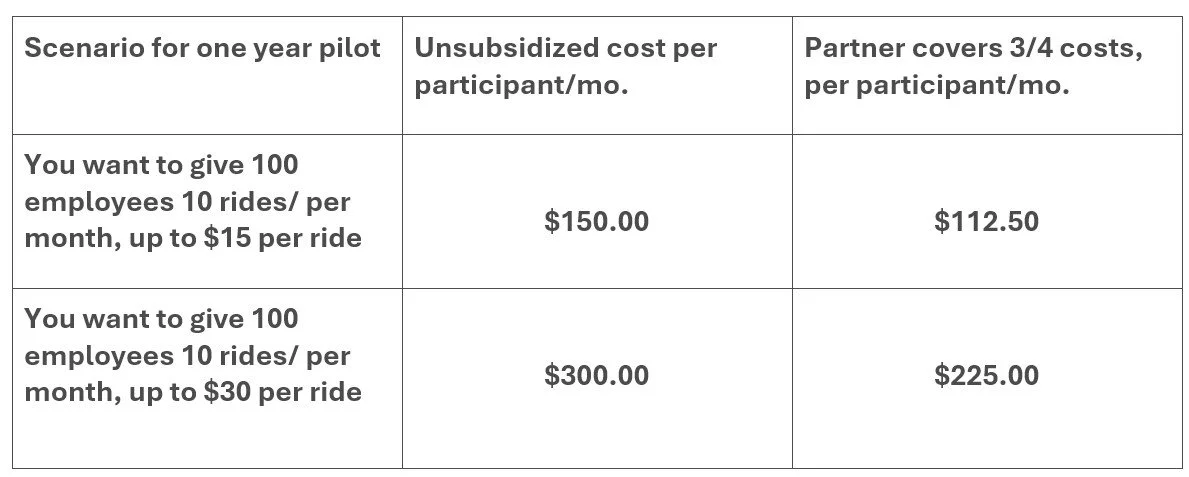
Below is a table that shows a guideline for how to budget for CT benefits in different circumstances that might apply for your grant. Please feel free to contact the CT team if you want to work through any specific budget ideas with us.
Letter of Support
If needed, we can provide a letter of support for your grant application. Please email us at info@commuterstrust.com with guidelines for the letter.
Questions? Email info@commuterstrust.com